
Silgan Holdings (SLGN): Initial Spin-off Analysis
Stock Spinoff Investing | October 30, 2026
On October 19, Silgan Holdings (NYSE: SLGN) announced a transaction that sets up one of the more interesting spin-off situations I’ve seen this year. It’s complicated, it will take time, and there are open questions I still need answered. But at around $40 a share, my early work suggests you are paying a reasonable price for Silgan’s higher-quality dispensing business and getting the future spin-off of its metal packaging business essentially for free.
What’s happening
Silgan is combining its metal food can and food and beverage closures businesses with Trivium Packaging, a European metal packaging company, to form a new company called Silgan Metal Containers and Closures (“Silgan MCC”). Trivium is being acquired for $3.4 billion, or 7.1x LTM EBITDA (4.8x including expected synergies).
The deal is being done alongside private equity firm American Industrial Partners (AIP). AIP is putting in about $1.0 billion of equity for a 40% stake in Silgan MCC, and Silgan keeps the other 60%. The rest is funded with new debt raised at Silgan MCC. Silgan also takes about $2.3 billion of cash out of the deal, which it will use to pay down debt. Closing is expected in mid-2027.
Silgan keeps 100% of its dispensing and custom containers businesses, which will be combined into Silgan Dispensing Solutions. Management has said it intends to eventually separate Silgan MCC through a tax-free spin-off. No timeline has been given; it will depend on integration progress, synergy realization and market conditions.
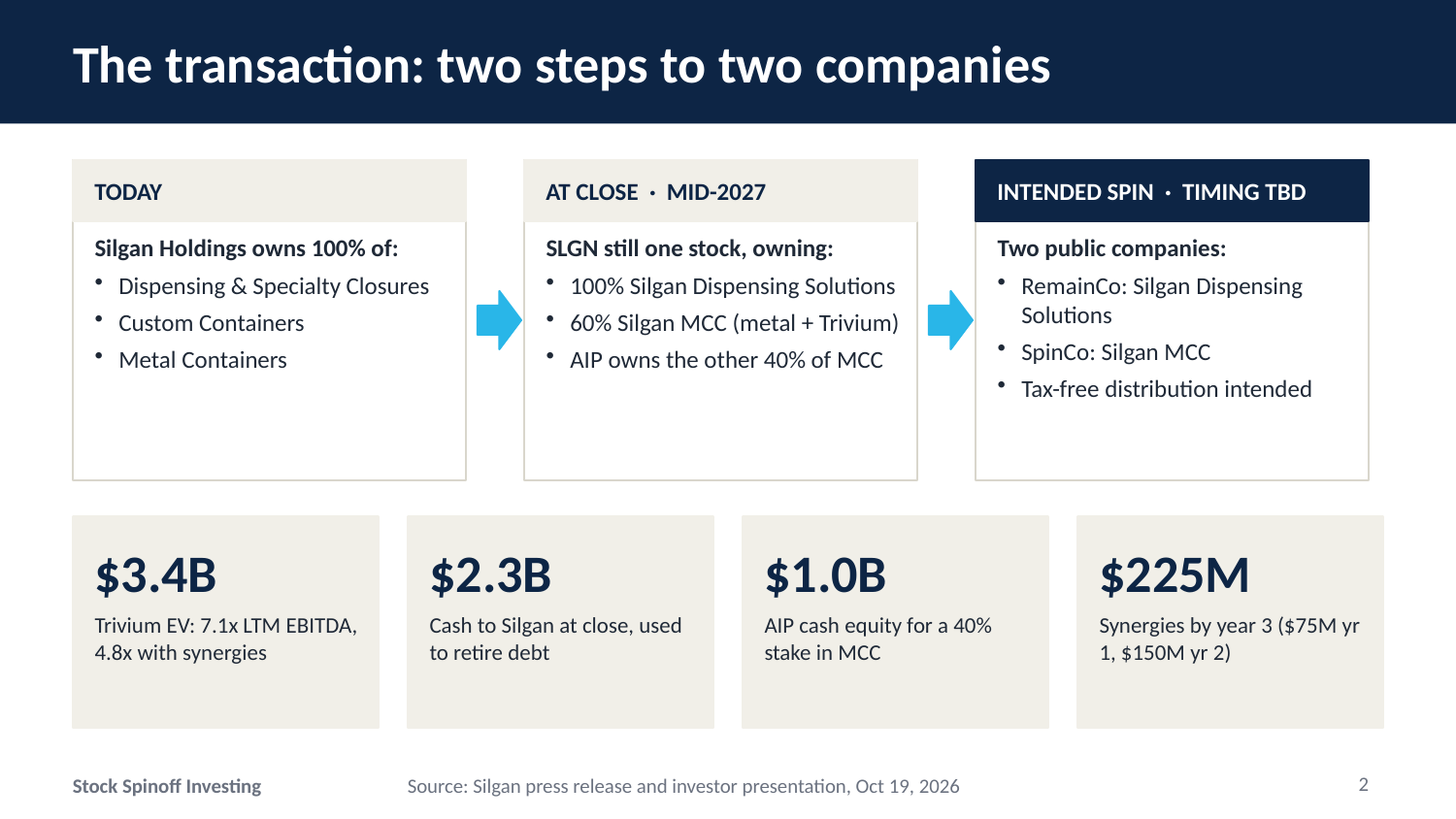
The transaction: two steps to two companies
Two very different businesses
The spin-off will leave two businesses with very different profiles. Silgan MCC is the larger, slower-growing, cash-generative can business, with about $7.3 billion of sales and $1.2 billion of EBITDA including $225 million of expected synergies. It will carry about 4.0x leverage on synergized EBITDA, or closer to 4.8x before synergies.
Silgan Dispensing Solutions, the RemainCo, is the higher-quality business: $2.5 billion of sales, $555 million of EBITDA, a 22% margin and only about 1.8x leverage. It makes pumps, trigger sprayers, fragrance and beauty dispensers, drug delivery devices and plastic containers, and management plans to use its balance sheet flexibility to keep growing it through acquisitions.
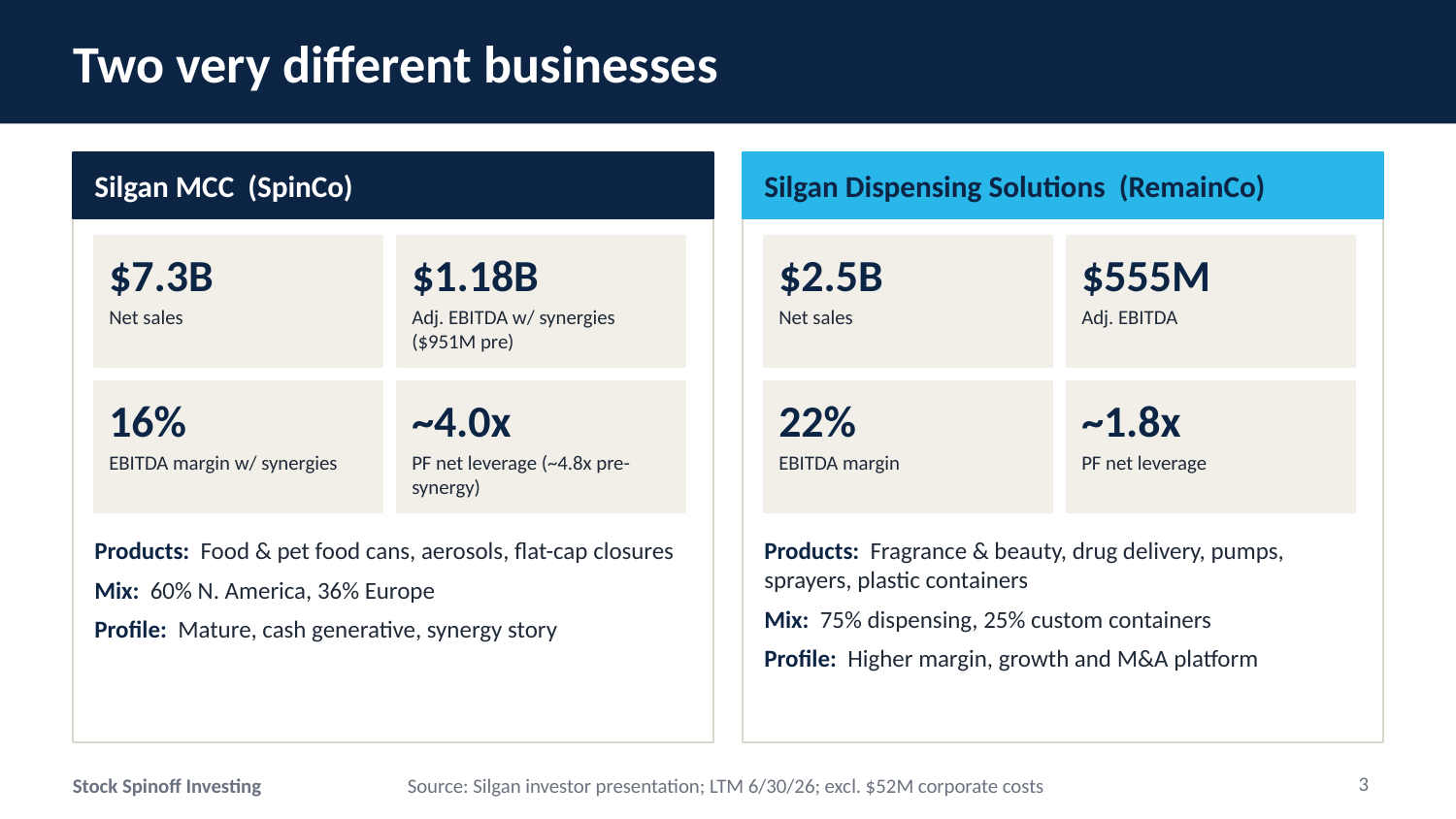
Silgan MCC vs. Silgan Dispensing Solutions
Why most of the value sits at RemainCo
This is the key insight. Silgan MCC generates roughly two-thirds of the combined EBITDA, but it also carries about $4.6 billion of net debt, and Silgan only owns 60% of what’s left. Dispensing Solutions carries only about $1.0 billion of net debt.
Using my base case valuation, Silgan’s 60% stake in MCC is worth roughly $15 per share, while Dispensing Solutions is worth roughly $44 per share. In other words, about three-quarters of Silgan’s equity value sits in the RemainCo. The MCC stake is effectively a levered option: each one-turn change in MCC’s multiple moves the stake by about $5.40 per share.
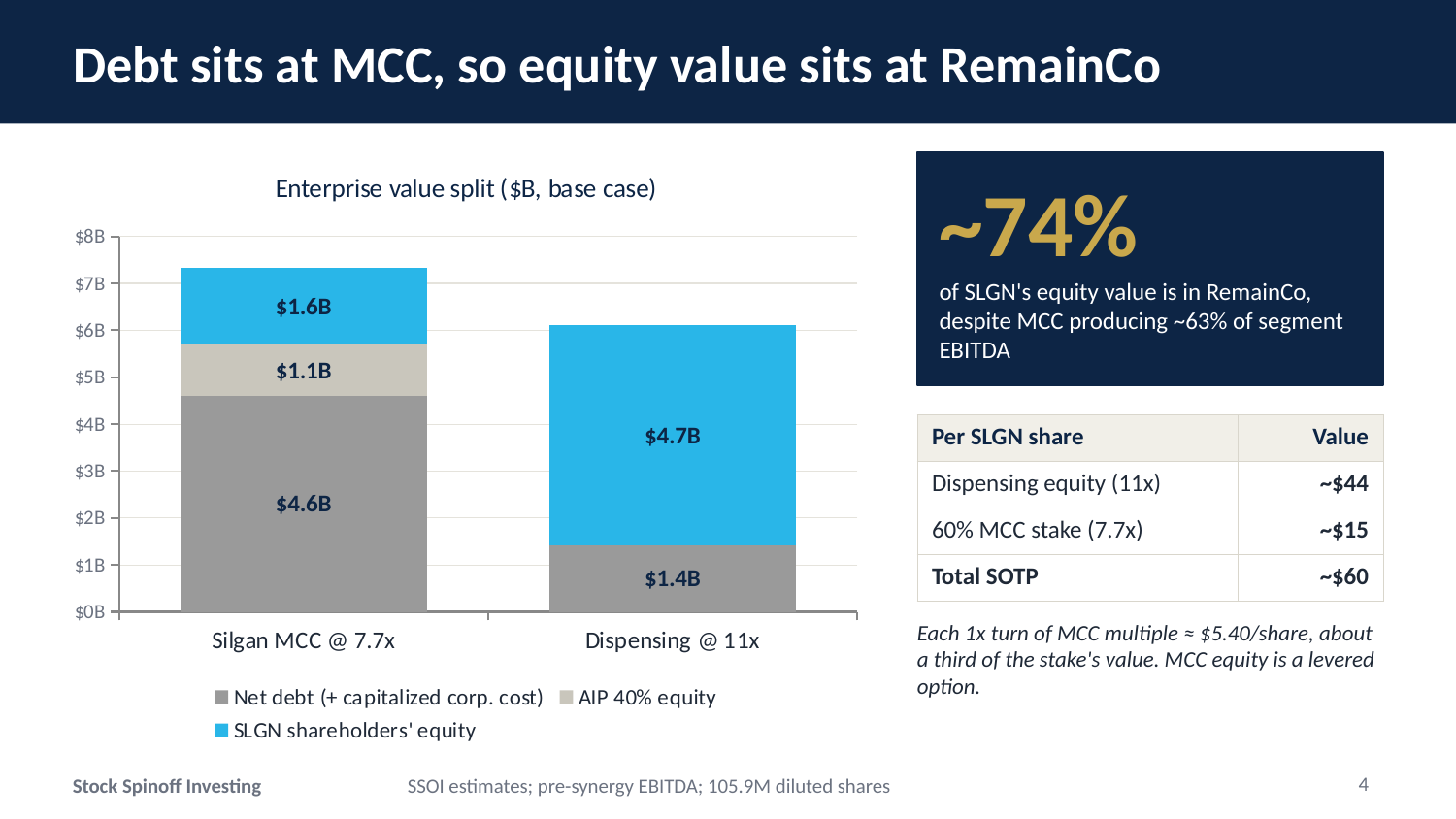
Debt sits at MCC, so equity value sits at RemainCo
Valuation: what the comps say
For Silgan MCC, I looked at the metal packaging peers. Excluding Ball, which is a beverage can pure play that trades at a premium, Crown, Ardagh Metal Packaging and Sonoco trade between 7.0x and 8.6x LTM EBITDA. The Trivium deal values MCC at about 7.5x pre-synergy EBITDA, right in that range, so AIP’s price looks like a credible mark.
For Dispensing Solutions, AptarGroup is the closest comp at 12.1x LTM EBITDA. I treat it as the ceiling since Aptar has a heavier pharma mix. West Pharmaceutical and Stevanato trade at big premiums as pharma pure plays, and Gerresheimer is a stressed situation, so I excluded them. Amcor, at 9.3x, is a reasonable reference for the custom containers business. Blending the two gets me to roughly 11x for Dispensing Solutions.
Notably, Silgan itself trades at 7.7x LTM EBITDA, in line with the can companies. The market is pricing the whole company like a can maker and giving the dispensing business no credit for its higher quality.
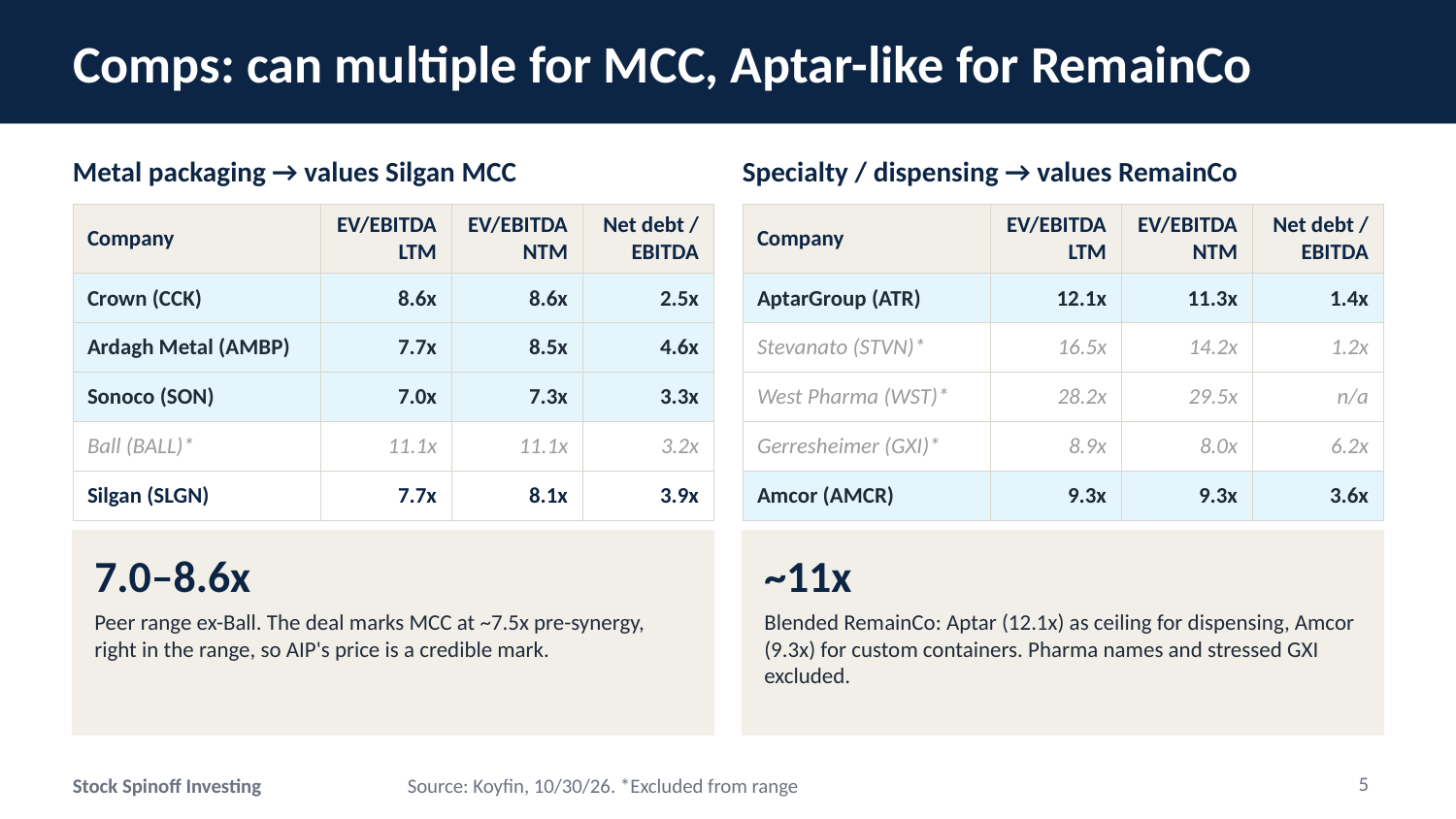
Comparable companies (Koyfin, 10/30/26)
Sum of the parts: getting the spin-off for free
Putting it together, my base case of 11x for Dispensing Solutions and 7.7x for MCC gets to about $60 per share, versus roughly $40 today, and that’s before any credit for synergies. If Silgan delivers the full $225 million, Silgan’s share is worth roughly another $10 per share. Even a bear case, with Dispensing at Amcor’s 9.3x and MCC at Sonoco’s 7.0x, comes out around $47.
Another way to frame it: if Dispensing Solutions is worth more than about 10.2x EBITDA on its own, the RemainCo alone covers today’s share price and the roughly $15 per share MCC stake comes for free.
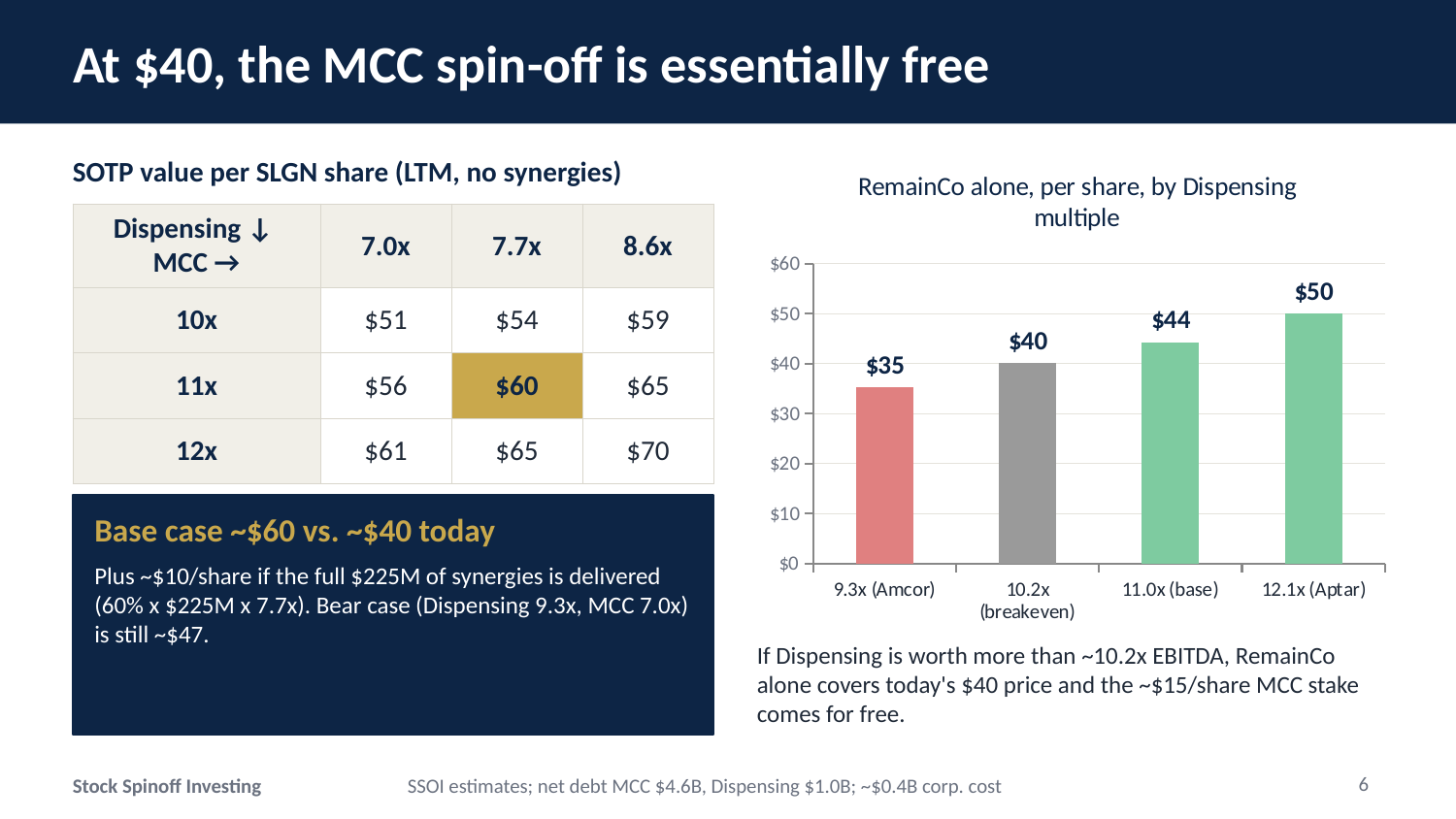
Sum-of-the-parts and the breakeven Dispensing multiple
What could go wrong
- Timing. The deal doesn’t close until mid-2027 and the spin-off likely comes in 2028 or later. The conglomerate discount may persist until then.
- Spin structure. Silgan will own 60% of MCC, but a tax-free spin generally requires the parent to control at least 80% of the subsidiary. I need to understand how management plans to get there.
- Synergies. The $225 million target is about 47% of Trivium’s EBITDA and drives the 15%+ accretion. Silgan has a good integration track record, but this is a much larger deal.
- Dispensing momentum. Dispensing and Specialty Closures adjusted EBIT was slightly down year over year in Q3. It’s hard to argue for an Aptar-like multiple while earnings are flat to down.
- MCC leverage and overhang. MCC starts at roughly 4.8x pre-synergy leverage, and AIP’s 40% stake will be an overhang once MCC trades publicly.
My take
This looks like a situation with real potential to unlock value. The structure pushes most of the debt into the metal packaging business, which leaves a cleaner, higher-margin RemainCo that the market is currently valuing like a can company. That said, this is a complicated situation and I’m still working through the details. I plan to speak with the company and do additional work to refine my assumptions, particularly around the spin-off structure, whether MCC’s debt is non-recourse to Silgan, the synergy targets and the RemainCo’s growth outlook.
It’s also important to be realistic about the timeline. The deal won’t close until mid-2027, and the spin-off is likely to come after that. This will take time to play out, and I’ll share more as my work progresses.
Figures are preliminary estimates based on company disclosures and Koyfin data as of October 30, 2026. This is not investment advice.
Leave A Comment