

MARKET COMMENTARY
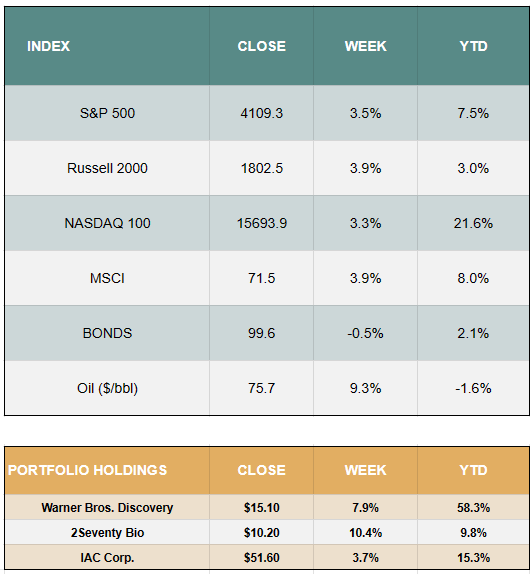
Last week, when I wrote, “we are clearly poised at an inflection point”, I had no idea that the market was going to conveniently develop a case of selective amnesia (what bank crisis?) and re-enter January’s bull run mode just in time to end the very volatile first quarter of 2023.
Over-all, it was a decent quarter for our holdings in the SSI: Ultra portfolio, with WBD being our best performer and TSVT the (relative) laggard of the group.
Source: S&P 500 & Author
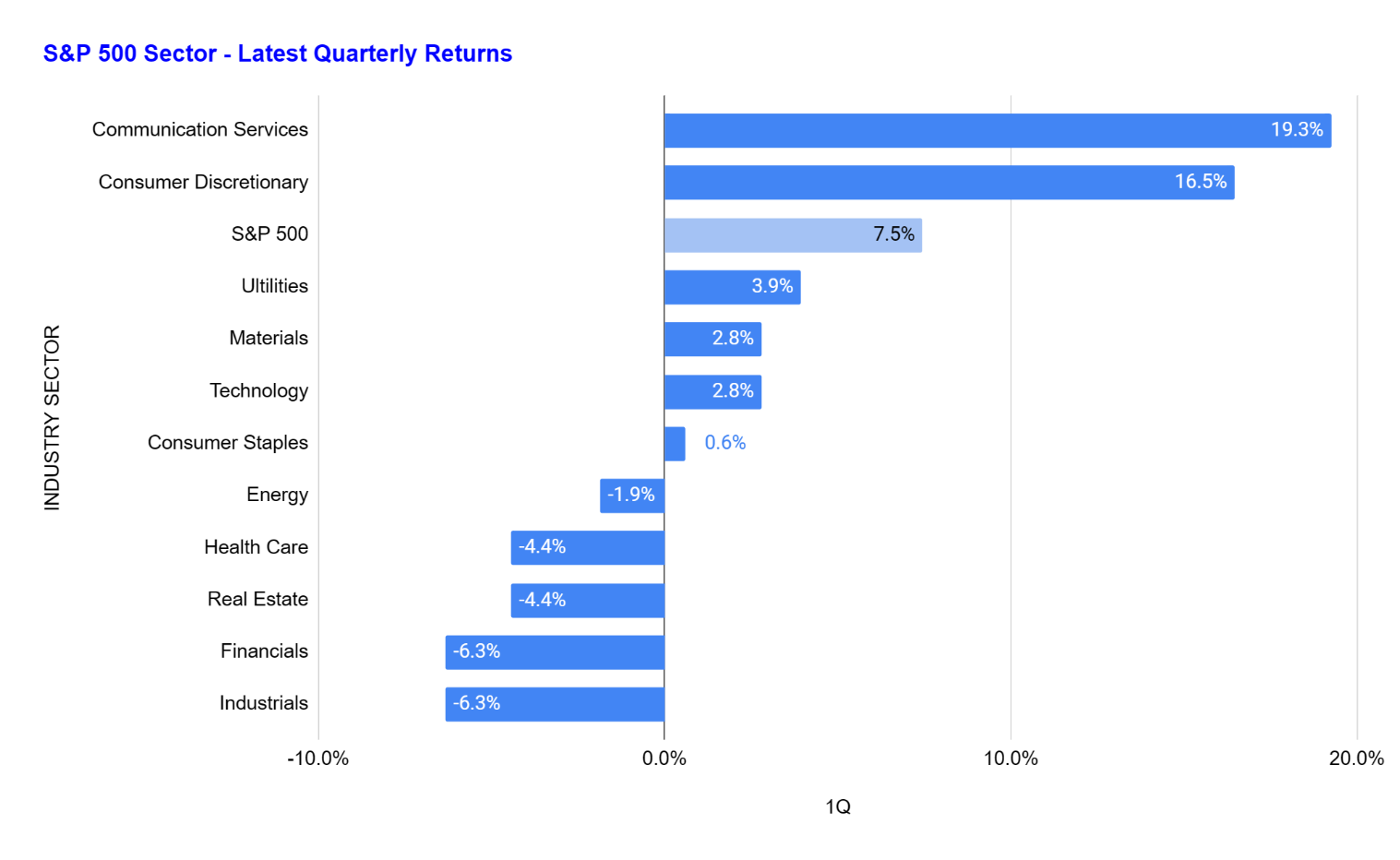
Taking a look at sector returns for the first quarter, we see that the S&P 500’s +7.5% over-all return for the period was almost entirely driven by outsized performance in just two sectors: Communication Services and Consumer Discretionary. WBD’s +59% return in Q1 2023 was a significant contributor to the impressive returns of the Communication Services sector, although it was dwarfed by Meta’s +76% return for the same period.
Also interesting to note that, of the two biggest lagging sectors, Financials and Industrials, the former was most affected by the actual impact of the Federal Reserve’s decision to aggressively hike interest rates, while the latter sector’s poor performance is more tied to the potential effects of the upcoming recession that those rate hikes are being anticipated to engender.
STAT OF THE WEEK
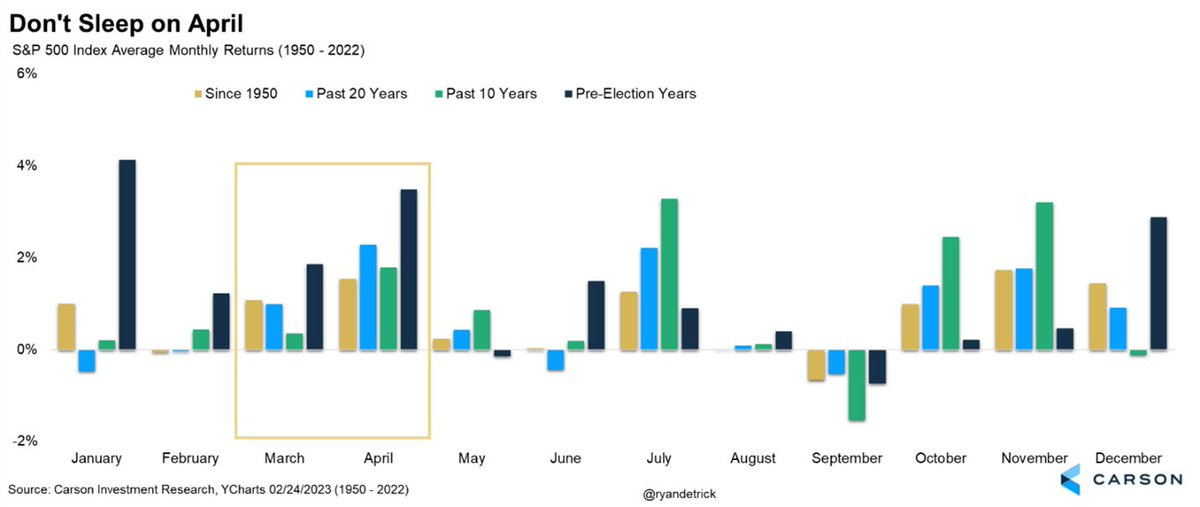
At the beginning of March, I put out a version of this chart showing how March and April are the historically strongest seasonal months for stock market returns. March delivered this year, with a +4% over-all return in the S&P 500. Let’s see if April will keep the positive returns momentum and streak going in 2023…
PORTFOLIO COMMENTARY
Warner Bros. Discovery (WBD) Diagonal Spread – I think we may have collectively underappreciated the impact of WBD’s success with Hogwart’s Legacy, which has been the best-selling videogame of 2023 since its release in mid-February. The 12 million copies and $850 Million in global sales it generated in just the first two weeks of its release certainly dwarf whatever underperformance at the box-office Shazam: Fury of the Gods produced. Although not without some (overblown) controversy, the game capitalizes on WBD’s irreplaceable IP (the Harry Potter franchise), as well as opens the door for future opportunities through sequels, a staple of the videogame industry.
In more mixed news, there are rumblings that the planned sale of WBD’s movie soundtracks catalog will not go through due to lower than expected bids. The sticking point appears not to be the valuation so much as the degree of control over the uses of the music that WBD desires to retain. The silver lining, as I see it, is that better-than-expected realized cash flow could be behind the decision not to sell at a heavy discount, and WBD retains a very valuable asset that it can monetize when interest rates are lower and, therefore, asset valuations higher.
Sources close to discussions told IndieWire that WBD CEO David Zaslav and his advisors hoped to receive up to $2 billion for the music catalog. However, potential buyers’ offers were affected by stipulations in negotiations that Warner Bros. Discovery retain control over how certain valuable soundtracks are used. As such, bids topped out around $1.2 to $1.3 billion. A person with knowledge of the talks said the discussions were very preliminary and that “no bankers” were involved.
2seventy bio (TSVT) Short Put – No new company news.
InterActiveCorp (IAC) Short Put – Showing that a queue is forming that’s just waiting on the IPO window to re-open, the car-sharing start-up company Turo recently updated its IPO filing paperwork to reflect its 2022 financial performance. As a reminder, the relevance for us is IAC’s 27% ownership in Turo (with warrants to purchase an additional 10%).
What does the new filing show us? It indicates that Turo’s growth out of the pandemic doldrums continued last year after posting rapid revenue gains in 2021. And that the company has reached new levels of profitability that may prove enticing to investors when the time comes.
In 2022 Turo generated revenue of $746.6 million, up 59% from the $469 million it brought into the business in 2021. That growth was powered, in part, by a large boost to spending at the company, which saw its sales and marketing costs grow from $52.7 million in 2021 to $111.3 million in 2022.
Given that Turo’s income statement after operating costs is a bit wonky, its adjusted EBITDA may ironically be a more useful… indicator of its profitability. Here we find that the company essentially matched its 2021 result of $81.1 million in 2022 when it reported adjusted EBITDA profit of $79.7 million.
Growth? Check. Profits? Check. Turo is ready to go public, and thanks to its S-1/A filing we know that it still wants to. At this point we’re merely waiting for it to kick off a roadshow.

Turo moving forward on its IPO could be a significant catalyst for IAC, considering the relatively low values attributed to the non-public pieces of its portfolio holdings.
Finally, an interesting piece was published last week that details the challenges of the integration process at Dotdash Meredith, and the progress that’s been made up to this point.
After the Dotdash Meredith merger closed in December 2021, the company expected the product integration to be completed by summer 2022. It’s still in the works. The delay ended up contributing to Dotdash Meredith’s year-over-year digital revenue decline in the third quarter.
“The scale and complexity was certainly unlike anything we had ever experienced before,” said McClean. “And so even though we had our best playbook and best estimations in place, we just couldn’t move fast enough.
One reason for the delay was the scope of the work. When the company previously had to move acquired publications onto its tech stack, it usually only had to concern itself with one publication at a time, and these publications were relatively younger publications without legacy product baggage. Meredith, by contrast, was the home to publications on the other end of the spectrum, publications like People and Entertainment Weekly that cannot just go dark to ease the integration process. In all, the company needed to unify the ad tech powering more than 40 publications.
…
And the work isn’t over. Just last week Dotdash Meredith completed the migration of Eating Well, a food publication that exemplifies the edge cases of what Dotdash Meredith’s product teams have had to deal with.
“They have really complicated advanced nutrition [content] that most nutrition providers for our recipes wouldn’t even offer. So we had to figure out how to build that whole new capability into the platform, whereas most of the other food brands were pretty standard,” said McClean.
Asked when he expects Dotdash Meredith to be 100% complete with the integration, McClean said, “I’m optimistically thinking we’re going to be done in Q2.”
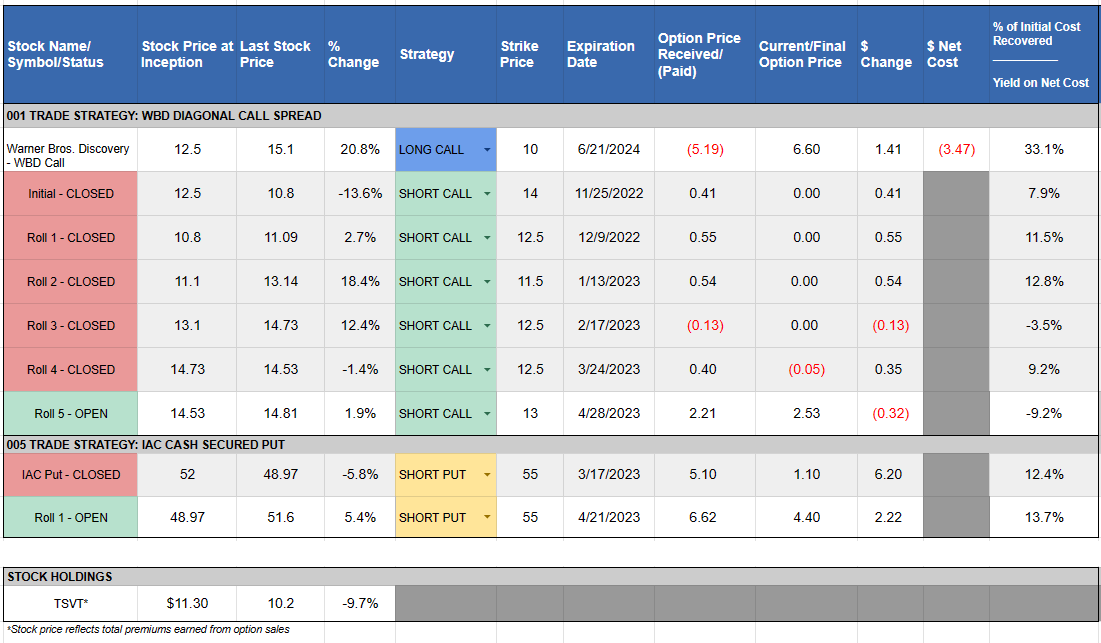
CURRENT TRADE POSITIONS
As always, hope that everyone has a great week!

Leave A Comment