Buy Medexus Pharma (MEDXF)
Market Cap: $34MM
Price: $1.38
Price Target: $4+
Upside: 189%+
Summary
Medexus Pharma (MEDXF) truly represents an asymmetric opportunity. The stock trades at 2x FCF and 5.2x EBITDA. Does the company have a lot of debt? No! Its net debt to EBITDA is currently 2.2x and will be 1.5x by the end of the year. Does the company have any catalysts? Yes! The FDA will decide on approving Treosulfan by October 30. If approved, Medexus revenue will double within 3 years while EBITDA and FCF will triple (Treosulfan has high margins). Are odds of approval good? Yes! The drug is already approved in the EU and Canada and improves overall survival. Are insiders buying? Yes! Insiders own over 10% of the company are currently buying in the open market. What is the upside potential? If Treosulfan is approved. Medexus’ EBITDA will grow from $20MM to $60MM+. Assuming the company’s EV/EBITDA multiple stays the same (5.2x), the stock will be worth $10. What happens if Treosulfan is not approved? I’m sure the stock will go down, but it’s already incredibly cheap (2x FCF) with a stable business and another catalyst in Q1 2025 (potential terbinafine hydrochloride approval, a $20MM to $30MM annual opportunity). That leads me to believe the downside is limited.
Medexus Business Overview
Medexus is a Canadian specialty pharma company. It doesn’t spend much money on R&D but rather acquires or in-licenses drugs that its specialty sales force can commercialize.
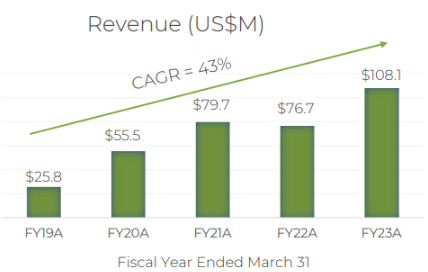
Medexus doesn’t break out individual sales on its drugs (I hope this changes), but I’ve included a screenshot of the consolidated numbers below.
Revenue and profitability have been growing nicely over time.
Revenue Breakdown
As mentioned above, Medexus doesn’t break out its sales by drug, but here are my estimates for revenue by drug:

I’m going to discuss each drug, its outlook, and patent protection.
IXINITY
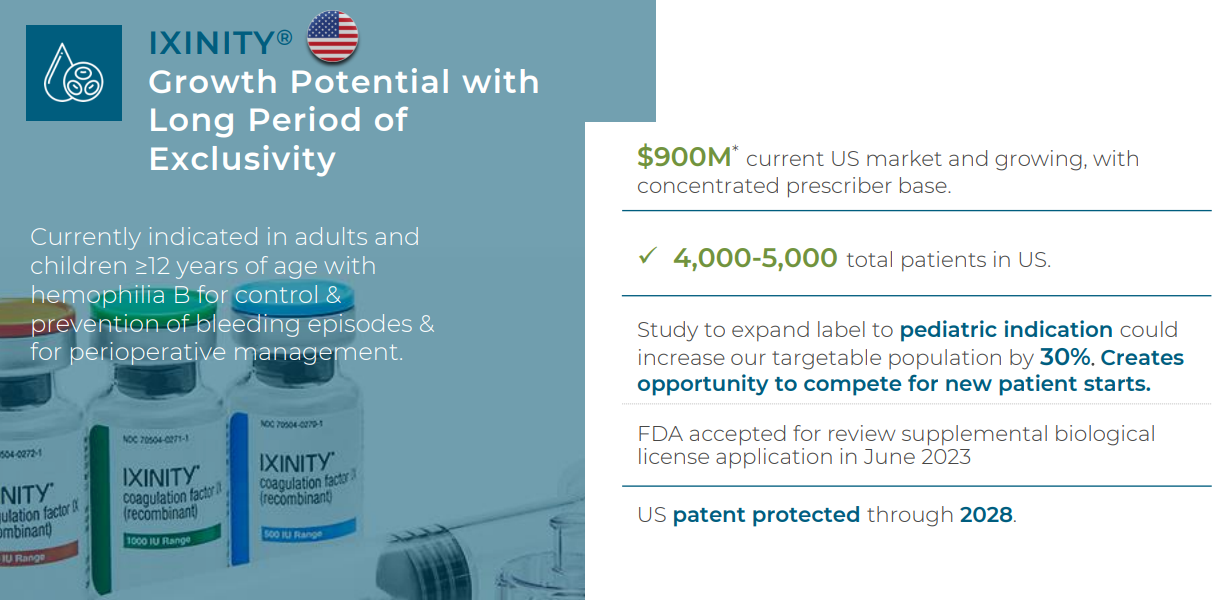
IXINITY is used to treat hemophilia B which is a billion USD market in the US. I estimate that IXINITY is generating $35MM of sales annually.
Medexus acquired IXINITY from Aptevo. It paid $30MM upfront, a 2% royalty until the pediatric trial was completed, and now a 5% royalty on sales through 2035.
While IXINITY has increased sales from $30MM in 2020 to ~$35MM in 2023, Medexus has not been able to market IXINITY to new patients because the drug is not approved for children under 12 years old.
The FDA recently approved IXINITY for pediatric patients. IXINITY has been shrinking over the past couple of quarters but this could reverse as IXINITY can now compete for new patient starts. Prior to pediatric approval, sales reps needed to convince a patient to switch from another drug to IXINITY (much harder sell than new patient start).
I estimate that IXINITY is currently generating $35MM of annual revenue. I’ve assumed -3% growth to be conservative.
IXINITY has patent protection until 2028. However, I do not expect significant generic competition because IXINITY is expensive to manufacture and a relatively niche market opportunity.
Rasuvo
Rasuvo is a single dose auto-injector of methotrexate. It is used to treat rheumatoid arthritis and psoriasis. I estimate that it generates $28MM of sales on an annual basis.
It has ~80% market share in the US. It’s used before patients progress to Enbrel, Humira and other drugs that are more expensive. Rasuvo is $6K per patient per year vs other biologics at $60K.
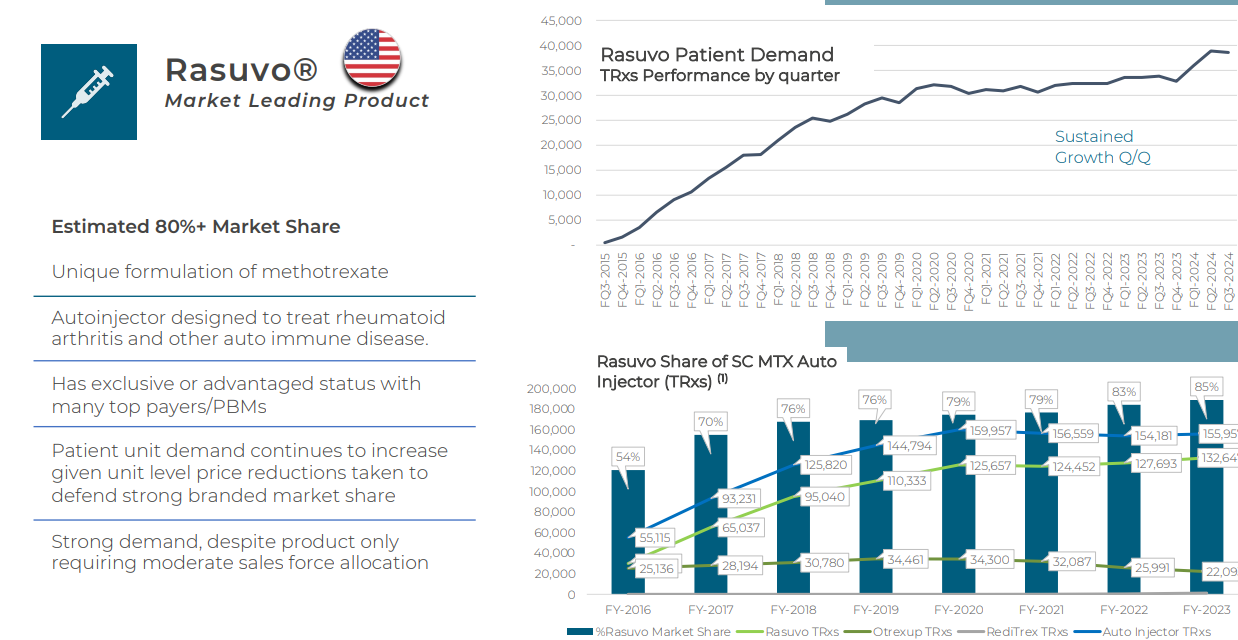
Rasuvo has been dealing with a competitive product that is trying to undercut it on price. Medexus has the lowest cost manufacturing and is matching the competitors price to keep its ~80% market share.
This drug has patent protection until 2029. I’m not expecting much growth, but I’m not expecting sales to fall off a cliff either.
Rupall
Rupall is a prescription antihistamine. It is marketed in Canada and is used to treat hives, seasonal allergies and year-round allergies.
It’s growing because physicians are switching patients from generic antihistamines and OTC products.
I estimate that Rupall generates ~$17MM of sales.
The drug is currently growing nicely (unit demand is +22% y/y). Data exclusivity will prevent generic entry in Canada before 2025.
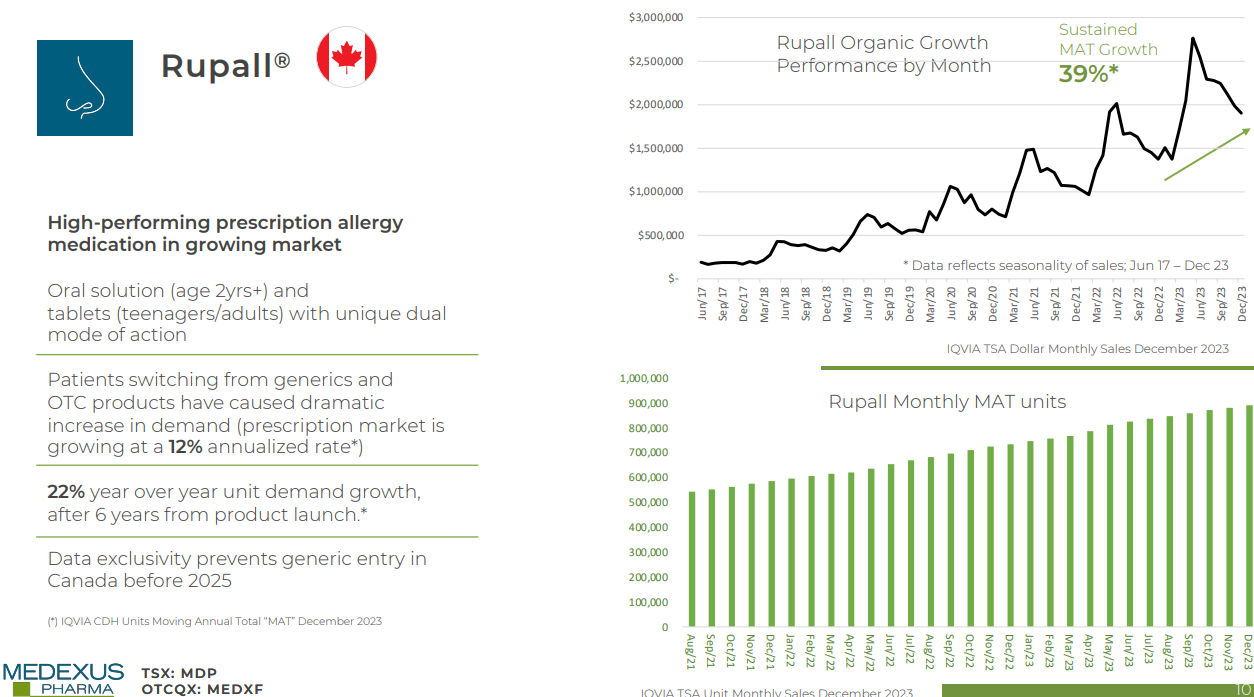
Once the product goes generic, sales won’t drop off a cliff. Why? Rupall is under the private insurance umbrella and these plans don’t push the generic option once a drug loses it
Gleolan
Gleolan is a tool that basically lights up brain cancer when it’s viewed under white light and makes it easier for surgeons to cut out malignant tissue.
It is a $5MM to $10MM opportunity in Canada when Medexus markets the product.
Medexus also recently received exclusive rights to commercialize Gleolan in the US. This represents a $12MM to $16MM annual opportunity.
I estimate 2024 Gleolan sales of $17MM.
Medexus’ licensing agreement runs through 2029.
Metoject
Metoject is the same drug as Rasuvo but is sold under a different name in Canada. It’s used to treat rheumatoid arthritis and psoriasis. I estimate that Metoject is generating $9MM of sales
Metoject had a generic competitor in the market. Despite generic competition, Metoject unit demand grew 13% in the 12 month period ending March 31, 2024.
Future Growth Drivers
Treosulfan
Treosulfan is Medexus’s biggest opportunity.
Medexus has licensed Treosulfan from German pharma company, Medac.
Treosulfan is given to acute myeloid leukemia (“AML”) and myelodysplastic syndrome (“MDS”) patients prior to stem cell transplantation.
It has been approved in Europe and Canada.
Patients who received treosulfan lived longer and had fewer side effects than patients treated with the generic alternative. Prior to going generic, busulfan (current standard of care) generated peak sales of $126MM in the U.S.
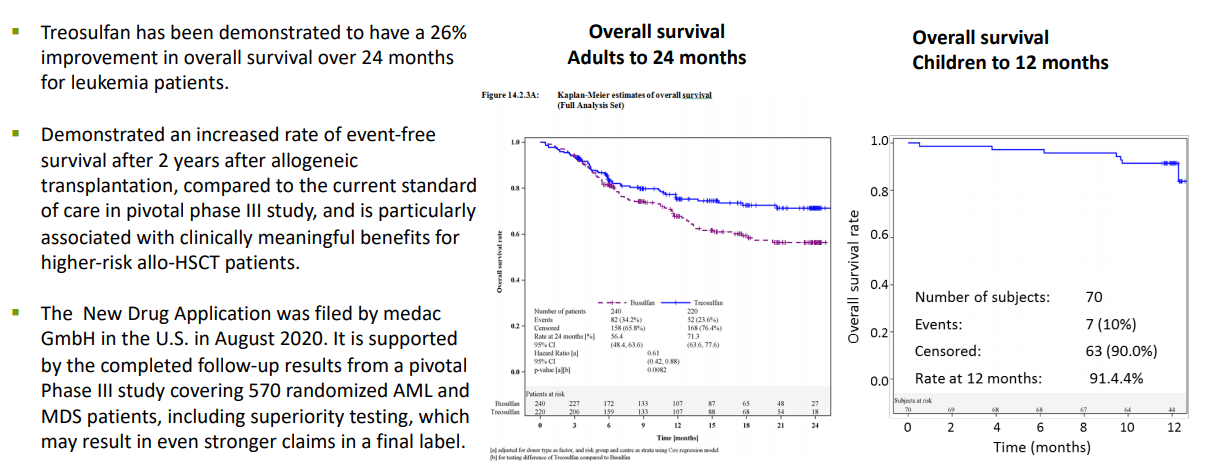
Given data showing favorable survival trends on a head to head study with busulfan, management believes treosulfan will ultimately be able to exceed $126MM of peak sales in the U.S. if it is approved.
Approval of Treosulfan was expected in 2021, but the FDA issued a complete response letter (CRL) requesting additional data.
It took medac (drug’s manufacturer) 3 years of back and forth, but finally the FDA accepted medac’s resubmission with additional data.
The FDA will make its decision by October 30, 2024.
If the drug is approved, it would be transformational for Medexus as sales would likely double over 3 years and EBITDA and FCF would triple (Treosulfan margins are very high).
Terbinafine
Medexus announced a licensing agreement to commercialize terbinafine hydrochloride nail lacquer. The product will be up for approval later in Q1 2025 and Medexus believes the total value of the Canadian fungicides market to be C$88 million annually.
Terbinafine represents a $20MM to $30MM annual opportunity.
Other Licensing Opportunities
Medexus has done an excellent job of securing additional licensing opportunities. The most recent example is Medexus securing the right to commercialize Gleolan in the US, a $12MM to $16MM market opportunity.
Putting it all together
All in all, I think in a “base case” scenario, Medexus should be able to grow revenue and EBITDA modestly for the foreseeable future.
While my “base case” is modest growth, I believe it’s highly likely that Medexus executes on a transformational new licensing opportunity whether that’s Treosulfan approval or another “IXINITY type” opportunity.
It’s impossible to model that with any certainty, but it feels to me that Medexus’ current valuation is far too low.
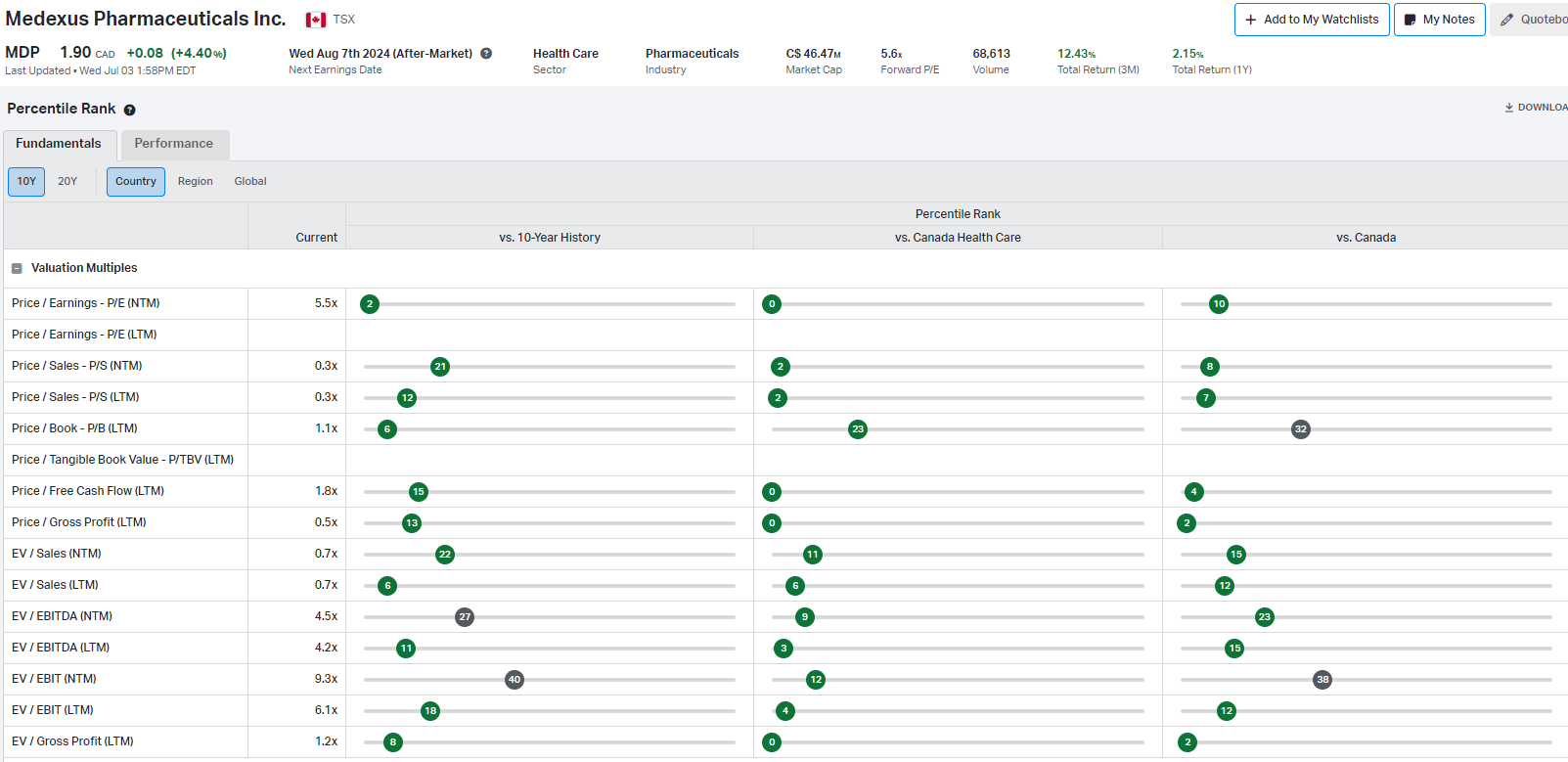
And Koyfin’s Percentile Rank function shows it’s extremely cheap vs its own historical valuation vs. Canada and vs. Canada Health Care.
Here is the company’s current capitalization…
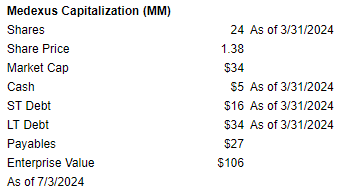
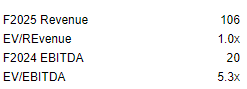
The stock trades at a market cap of $34MM and an enterprise value of $106MM. As such, it’s trading at 1x revenue and 5.3x EBITDA.
What is the right valuation?
It’s tough to say with certainty but here’s how I think about it….
Large cap specialty pharma companies, Bausch Health (BHC) and Jazz Pharmaceuticals (JAZZ) trade at 2.6x and 2.5x NTM Revenue, respectively.
Then you have smaller Canadian small cap specialty pharma peers…
Cipher Pharma (TSX: CPH) trades at 4.7x revenue and 8.0x EBITDA..
HLS Therapeutics (TSX: HLS) trades at 2.5x revenue and 8.4x EBITDA.
Knight Therapeutics (TSX: GUD) trades at 1.3x revenue and 7.6x EBITDA.
Given the above, a 1.3x revenue multiple (inline with GUD) and 6.6x EV/EBITDA multiple seems reasonable in a bearish scenario.
At a 1.3x revenue and 6.6x EBITDA, MEDXF is worth $2.50, 81% higher than where the stock currently trades.
Now let’s think about a bullish scenario.
Assuming Treosulfan gets approved, we are going to have line of sight to $200MM of annual revenue and $60MM+ of annual EBITDA.
Let’s further assume the stock’s EV/EBITDA multiple stays the same (5.3x).
A 5.3x EBITDA multiple on $60MM of EBITDA implies an enterprise value of $316MM, market cap of $245MM, and share price of $10, over 600% upside from current levels.
I actually think it should trade close to 8x EBITDA, but let’s not get carried away.
How Likely is The Upside Scenario?
According to Statistica, once a drug makes it to phase III, its historical odds of FDA approval is 57.8%
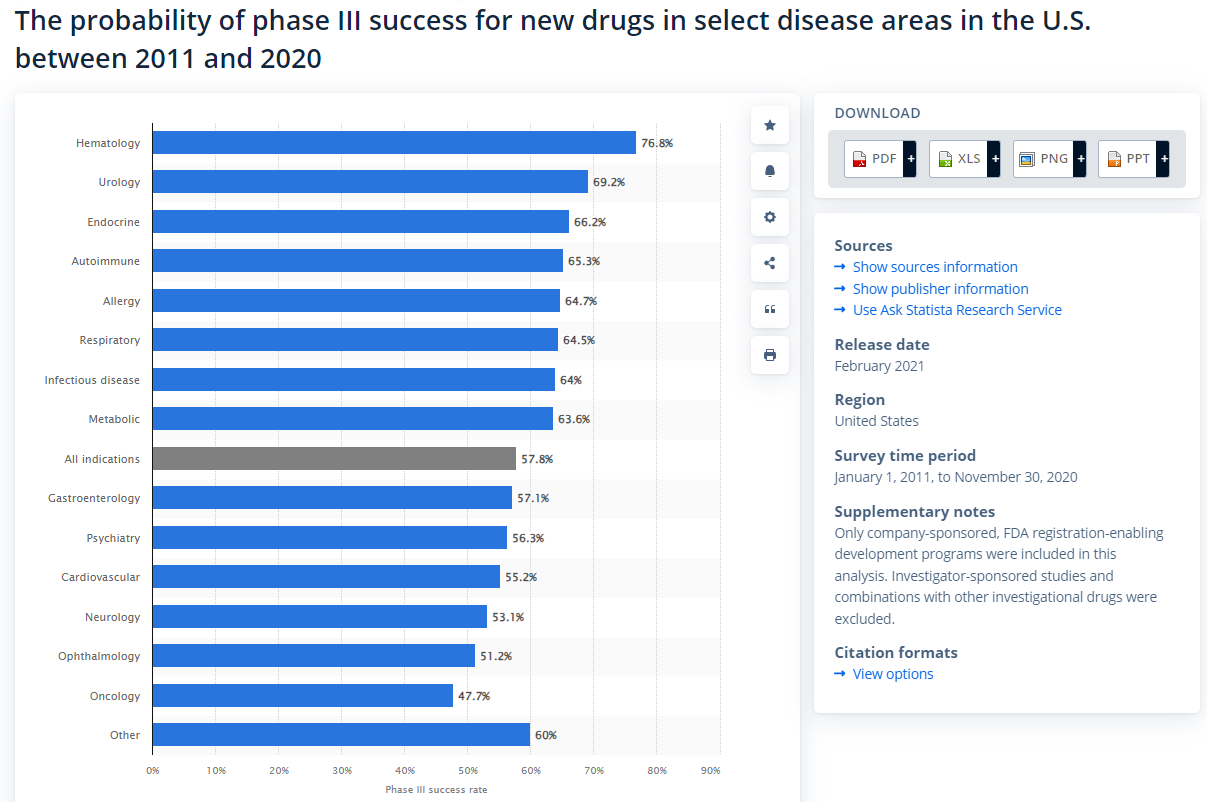
Interestingly, Treosulfan’s disease area, hematology, historically has had 76.8% approval rates. Here is a link to another study on historical approval odds of phase III drugs.
We can also look at odds of approval for drugs that receive a complete response letter (CRL) which Treosulfan received.
A Datamonitor study found that 55% of drugs that received a CRL were ultimately approved.
Based on these historic probabilities, I think 50% odds of approval for Treosulfan is reasonable/conservative.
I think the stock is easily worth $10 in a scenario where Treosulfan is approved, but let’s assume it’s only worth $5 in a Treosulfan approval scenario to be conservative.
50% x $5 per share = $2.50 of expected value
In the scenario where the FDA does not approve Treosulfan, we can assume the stock declines by 20% ($1.38 x 80% = $1.10). I could argue the stock shouldn’t decline at all given that it is so cheap, but let’s assume a 20% decline.
Assuming 50% odds, we get $0.55 of expected value in that scenario.
Treo approval scenario: $2.50 per share of expected value
Treo not approved scenario: $0.55 per share of expected value.
Total expected value = $3.05 (+121% from current price).
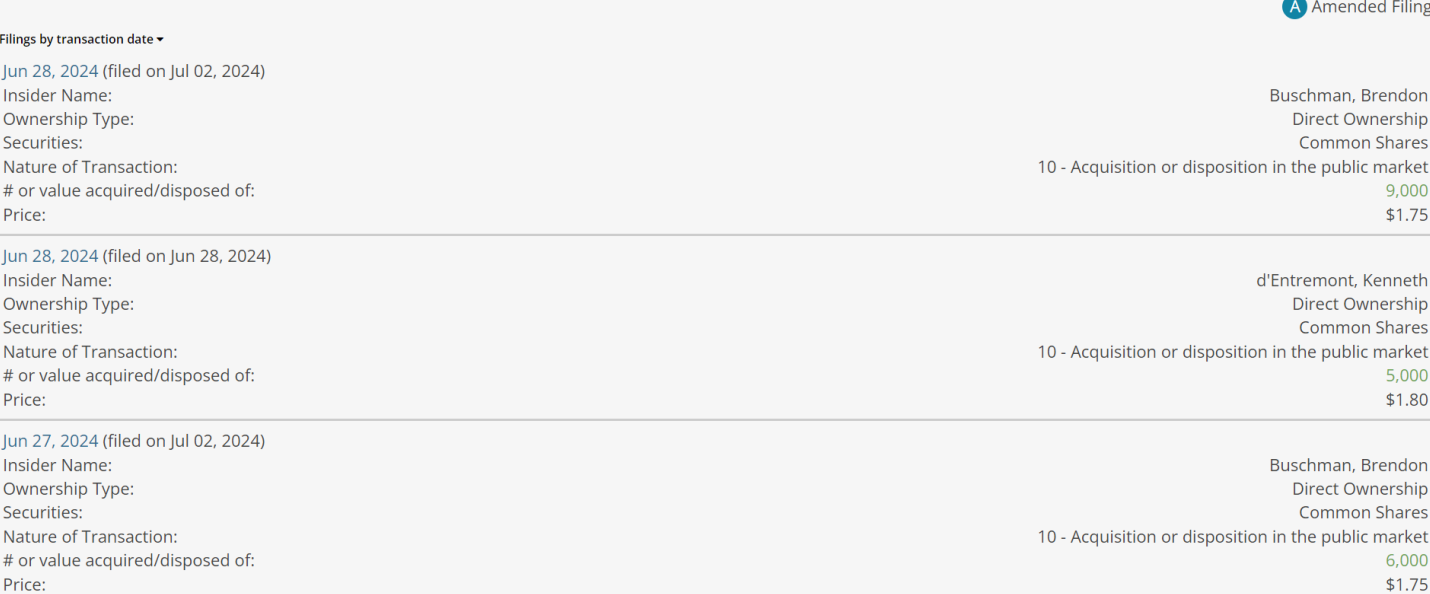
Are Insider Buying?
Yes insiders own ~10% of shares outstanding and have been buying in the open market.
Risks
Micro-cap Risk
- MEDXF is a micro-cap. Micro-caps can be incredibly volatile and liquidity is low. Only investors who are comfortable investing in high-risk, micro-caps should consider investing in MEDXF.
Revenue Concentration
- Two drugs (IXINITY and Rasuvo) make up 60% of sales. Both drugs are facing challenges but provide stable cash flow. Medexus continues to diversify its revenue base, but this concentration is a risk.
Debt
- Medexus has $46MM of net debt which is a significant but manageable burden for the company given its strong EBITDA ($20MM annually) and free cash flow generation ($15MM annually).
Patent Expirations
- 80% of drug sales won’t be subject to generic competition before 2029. But Rupall’s patent expires in 2025 which will enable generic competition. I’m doing additional research to determine the revenue headwind caused by this patent expiration (in some instances, generic competition results in a sharp revenue decline, in others, the fall off is more moderate).
Treosulfan isn’t Approved
- This would be very disappointing and would eliminate the immediately upside scenario. However, I believe the base business is undervalued and Terbinafine could be a $20MM to $30MM annual revenue opportunity (Q1 2025 approval expected).
Disclosure/Disclaimer:
Rich Howe owns shares of MEDXF. All expressions of opinion are subject to change without notice. All published emails/articles/correspondence is provided for informational purposes. We do not warrant the completeness or accuracy of this content. Please do your own due diligence and consult with an investment adviser before buying or selling any stock mentioned on www.stockspinoffinvesting.com.




Leave A Comment