

3 High Conviction Buys From China
In May, I attended the Berkshire Hathaway annual meeting for the first time.
It was awesome.
A bit of a circus / cult gathering? Yes. But it was quite fun to be part of the circus.
I loved listening to Buffett ramble on for 8 hours answering shareholder questions (can’t believe his stamina at 93!).
But my favorite part of the weekend was connecting with “my online friends.”
There were a bunch of people that I had interacted with over email and through Twitter, and it was great to connect with them in person.
I also had the chance to meet new friends.
One such friend is Nicolas Michel, an analyst at China Focused fund, Banyan Partners.
Nicolas and I bonded over our mutual love of Liquid Death.
And I made Nicolas promise me that when he got back to China he would send me three of his favorite China ideas.
Why?
Because China looks really interesting!
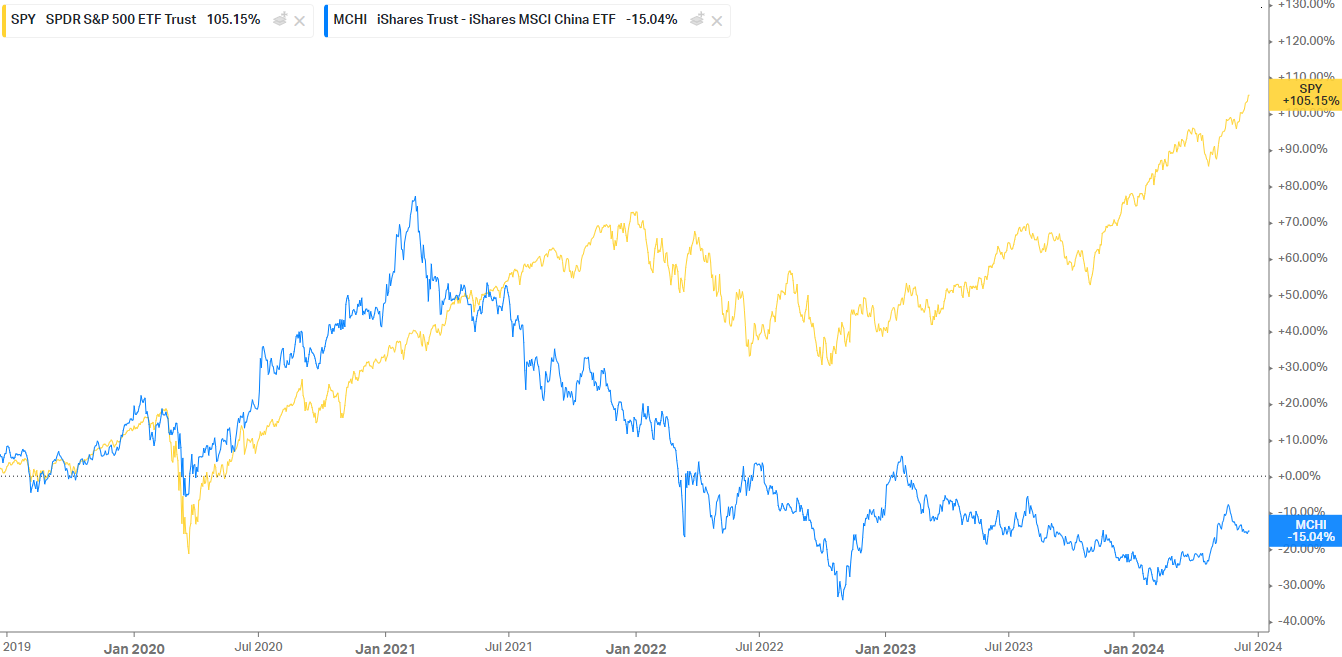
Over the past 5 years, the S&P 500 is up over 100%. Meanwhile, iShares MSCI China ETF is down 15%.
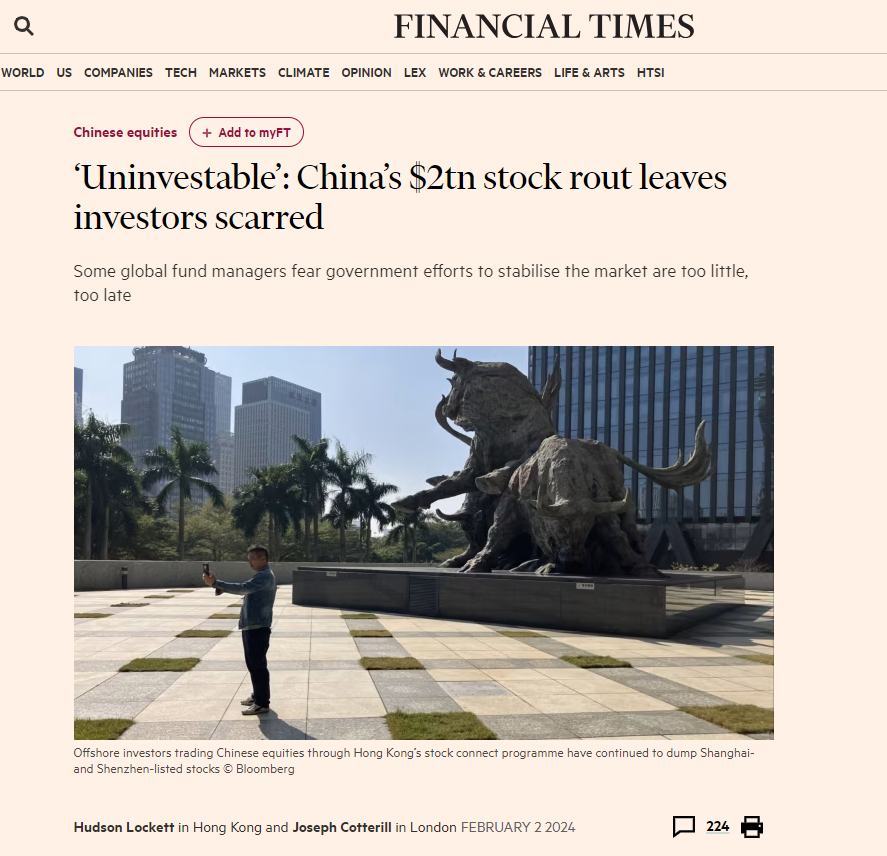
And sentiment is bad…
But I still have concerns…
What if the company that looks cheap on paper is an actual fraud?
That’s why I think you need to be an expert and “on the ground in China” to be successful.
Nicolas (the analyst that I met in Omaha) and Xin Wu (portfolio manager) manage Banyan Partners, a long short hedge fund based in China.
Since its founding in 2014, Banyan has generated 8.2% annualized returns, beating the CSI 300 (China index that includes 300 largest companies) by 7.7% per year.
I asked Nicolas and Xin to share three of their highest conviction ideas.
Without further ado, here’s what they shared with me:
Andon Health (SHE: 002432)
As described by Rich and supported by public opinion, China is cheap. So much so that in over 15 years of investing in stocks in China, this is the first time we have found sound companies trading below their cash value.
Andon Health, in one sentence, is a fair company at a great price. The company has a stable, cash-generating B2C medical supply business while currently trading at cash, with two major catalysts to unlock value: new contracts and continued buybacks.
The company sells its medical B2C products overseas under the “iHealth” brand, available on its own website, Amazon, and Walgreens. The products include blood pressure monitors, thermometers, glucometers, wireless scales, and test kits. The “Jiuan” brand mainly sells domestically, offering products such as nebulizers, nasal irrigators, and blood pressure monitors. The industry is highly competitive, and before the start of COVID-19, Andon was losing money. However, in November 2021, their COVID-19 antigen test was approved by the FDA for over-the-counter sales. There were only eight other approved tests at that time, so the US government and retail outlets purchased directly from Andon in Q1 2022. This resulted in revenues of 26.3 billion RMB in 2022, compared to 0.7 billion RMB in 2019, 2.0 billion RMB in 2020, and 2.3 billion RMB in 2021. The huge jump in revenues led our automatic financial analysis tool to detect the company. However, we were not the only ones, and the market price increased tenfold in two months. At this point, we did not invest because we were wary of a common occurrence with family-owned Chinese businesses: they often jump on the latest fad and waste money on unrelated ventures. We decided to wait and see.
The management of Andon did not engage in self-destructive actions and instead prudently invested in US Treasuries with different maturities. When we add the cash together with these risk-free treasuries and deduct the debt, we arrive at 19.4 billion RMB. We bought when the market cap was slightly below that. The current market cap is around 20.4 billion RMB.
There is no reason to believe the rest of the business should be worth only one billion RMB. In 2023, Andon generated 3.2 billion RMB in revenue with a net income margin of around 15%. Excluding government orders and pandemic-related test kit demand, normal revenue is estimated from Q2 2023 and Q3 2023 levels (0.8 billion RMB and 0.4billion RMB, respectively), averaging 0.6 billion RMB per quarter or 2.4 billion RMB annually, indicating growth compared to pre-pandemic levels.
The market is overlooking this opportunity because Andon is small, with a market cap of 20.4 billion RMB (2.8 billion USD) versus around 3 billion RMB (0.4 billion USD) before the pandemic. Consequently, there is zero sell-side coverage. Additionally, all the ratios are skewed because of the COVID-19 outlier. The cash is also not visible without going through the annual report.
Catalysts to unlock the value include continued buybacks, which have already amounted to 5.5% of shares outstanding YTD as of May, revenue collection from the new US government order at the beginning of the year, and new government contracts for the newly approved combined COVID-19 and flu test.
Goneo Group (SHA: 603195)
Goneo, in one sentence, is a great company at a fair price. The company is a category-killing civil electrical engineering firm with 10-15% revenue growth, a stable 20% net income margin, no debt, an industry-leading 27% ROE, majority family ownership, and continued growth potential in EV and overseas expansion. Additionally, Goneo profits when Chinese real estate recovers. The valuation is relatively high at an EV/EBITDA of 19.2 and a PE of 27, on a LTM basis, but fair given its proven ability to enter and excel in new business areas and to compound for many years.
Goneo was founded in 1995 and started with electrical connection products like extension cords, power strips, USB sockets, and travel converters. In this category, where most sales go through mom-and-pop shops, Goneo dominates with an estimated 80% market share in China. For online sales in 2023, Goneo holds a 56% market share, with the second-largest company at 6%. Goneo stands out with its brand recognition as durable and safe, which makes customers willing to pay a premium. This recognition stems from being the first producer in 1995 to deliver a high-quality and safe product at a 50-60% premium to its peers, being the first mover in many rural areas in China and providing free store signs with its logo to mom-and-pop stores across the country. With its achieved scale and vertical integration over the years, it is now also the low-cost producer. This segment provides 48% of Goneo’s revenue, has stable 5% growth, and gross profit margins of 41%.
The second category was launched in 2007 with intelligent electrical lighting products, such as wall switches and LED lighting. Competing with global giants like Siemens and Schneider, which have 8% and 7% market shares respectively in 2023, Goneo holds 34% online market share. This segment represents 50% of the revenues with a gross profit margin of 46%. Even though China is going through a real estate crisis, this segment grew 15% year-over-year, demonstrating its resilience. Whether for new buildings or renovations, new electrical items must be purchased. Additionally, it is a small-ticket item, with an average of less than 5% of the budget spent on electronical items yet a source of serious security concern for electrical failures that could cause fires. We see an upturn in real estate as a catalyst for even more growth and profits.
The management has done an impressive job in these two segments, achieving a roughly 10 percentage points higher ROE than competitors. In 2022, they started a new EV charging venture and delivered 149% year-over-year growth, with a gross profit margin of 34% and a market share of 11%, placing it in third place. With the massive EV boom in China, there is a long runway. The same goes for its international expansion, which started in H2 2023 and will target Southeast Asia and Europe. Our core thesis is that if you are a category killer in the homeland of competitiveness for cheap electronic goods, you can be successful worldwide.
85% of the shares are family and management-owned, showing strong alignment with shareholders. The low float is of no concern due to the generally high liquidity in Chinese A-shares. The 1 billion RMB in debt is also of no concern with 14 billion RMB in cash. This company is a candidate to hold for the long term if they can keep up the excellent execution.
Yuyue Medical (SHE: 002223)
Yuyue, in one sentence, is a great company at a fair price. The company is the leader in household medical devices in China, boasting a 50% gross margin, a 20% net income margin, and a 30% return on capital, while having quadrupled its revenues over the past ten years. The founders hold 43% of the company. Yuyue benefits from several trends in China, such as an aging population and increased spending on healthcare. The valuation, at 16.7 EV/EBITDA and 27.1 P/E, on a LTM basis, is fair given its strong industry position and significant tailwinds.
Founded in 1998, Yuyue develops, manufactures, and sells household medical devices and clinical products. It focuses on five primary segments: respiratory oxygen generation, diabetes management, infection control, household electronic testing, and in vitro diagnostics. Additionally, it has incubated high-potential businesses such as life support information (first aid), ophthalmology, and intelligent rehabilitation. The company offers over 600 product categories with nearly 10,000 specifications. Historically, many products in China were imported due to better quality, e.g. Japan’s OMRON, but Chinese companies have caught up and even lead in R&D efforts while producing more cost-effectively. Familiarity with local sales channels also contributes to their success. These factors, together with management’s excellent execution, have made Yuyue the number one household medical device seller on JD.com and Tmall for China’s Singles’ Day shopping festival for eight consecutive years, demonstrating strong consumer trust that is hard for competitors to replicate across so many products.
Confluence of the following three key trends in China support continued growth: an aging population with more chronic diseases, increased disposable income used for healthcare, and a specific focus on home care. In China, hospitals serve as the primary point of care for patients. Unlike in Europe and the US, where primary care is typically provided by family doctors or general practitioners in small clinics, in China, patients go directly to hospitals for both general health issues and specialized treatments. This centralization means that hospitals handle a larger volume of primary care cases, often resulting in extremely short consultations and long queues. Therefore, especially for chronic diseases, patients prefer to avoid hospitals and buy home care products. While healthcare provided at hospitals is subsidized by the government where drugs and equipment are bought through centralized procurements which put a lot of pressure on pricing, B2C medical devices do not undergo this process and enjoy market pricing.
The founder and his son, who is also the CEO, own 43% of the company, aligning management with shareholder interests. Since going public in 2008, Yuyue has increased over 2000% in value but is still only worth 40 billion RMB (5.5 billion USD), while being very conservatively financed with only 1 billion RMB in debt and 9 billion RMB in cash. The industry is poised for growth, and Yuyue is well positioned to continue to grow revenues 10-15% annually with margins at around 20%. This is a company to hold for the long term.
Can you actually buy these stocks?
Yes!
Using Interactive Brokers, you can buy all of these stocks!
Want more information about Banyan Partners or want to talk about Chinese stocks with Nicolas and Xin?
Reach out to them directly at nicolas@banyanpartners.cn and xin@banyanpartners.cn!
On LinkedIn, you can connect with Nicolas here and Xin here.



Dear Richard,
Thank you very much for the kind introduction and the opportunity to publish our thoughts!
To all readers, please do not hesitate to reach out if you have any questions about China. We are more than happy to help!
Kind regards, and we look forward to your messages.
Nicolas
Thanks Nicolas!!