
How to Profit from “Demerger Arbitrage”
One popular special situation category is merger arbitrage.
In merger arbitrage, an investor buys the stock of a company that is in the process of being acquired.
The investor profits when the acquisition closes.
Let’s take a recent example.
On September 5, 2024, Verizon (VZ) announced that it has agreed to acquire Frontier Communications (FYBR) for $38.50 in cash.
Immediately after the news broke, FYBR’s stock price shot up and now trades at $35.65. The deal is expected to close within 18 months.
An investor could buy FYBR for ~$35.65 today and receive $38.50 in 18 months. That works out to a 5.5% annualized return.
I’ve never been that interested in merger arbitrage.
A 5.5% annualized return over 18 months just doesn’t do it for me.
Especially considering that FYBR would probably trade down to $28 if the deal fell apart. The setup seems asymmetric in the wrong direction.
“Demerger arbitrage” is a category of special situation investing that I find much more interesting.
Here’s how it works.
- You look at a company that has already announced a spin-off.
- You do a sum-of-the-parts valuation analysis to determine what value will be unlocked by the spin-off.
- If the spin-off will clearly unlock value, you buy the stock before the spin-off and wait
- Once the spin-off takes place, you sell both the spin-off and RemainCo. If your valuation analysis was correct, you make money.
While this sounds simple, it can get a bit complicated.
Valuing a potential Spin-off and RemainCo takes judgment and depends on market conditions. For these reasons I only buy “demerger arbitrage” situations that look like obvious opportunities..
Let’s discuss a few “demerger arbitrage” situations….
A Tiny Spin-off
First, let’s start with a tiny Canadian company called High Arctic Energy Services (HGHAF).
In April 2024, High Arctic announced that it would return ~50% of its market cap through a return of capital and then break up into two public companies.
My conservative SOTP analysis suggested a fair value of $1.76/share to $4.31/share CAD.
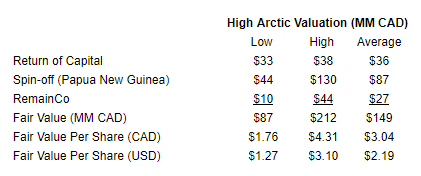
At the time High Arctic traded at $1.29. So this qualified as a “no brainer” valuation.
What happened?
The situation played out pretty much as expected. Investors received a $0.76 CAD return of capital and then the company broke up into two companies.
After the spin-off, RemainCo looked reasonably valued so I sold it, but I’ve hung onto shares of the spin-off, High Arctic Overseas Holdings (HOH.V).
Why?
HOH.V is currently trading at $1.59 CAD. I think it’s worth between $3.43 and $11.49. In other words, I see 100%+ upside to my “low” valuation.
Nonetheless, my High Arctic recommendation has worked out well so far (even with a deeply undervalued spin-off).
So far, we’ve generated a total return of 17.3%, beating the S&P 500 by 3.8% and beating the Russell 2000 by 4.7%.
Shedding a Money Loser
One surefire way to create value is to spin-off a money losing division.
Public companies usually don’t get “credit” for money losing divisions and they drag down consolidated results.
When a public company spins off its money losing division, its parent company’s financials improve. Earnings improve and so the parent company’s P/E ratio looks more attractive.
This is what happened with two recent spin-off transactions….
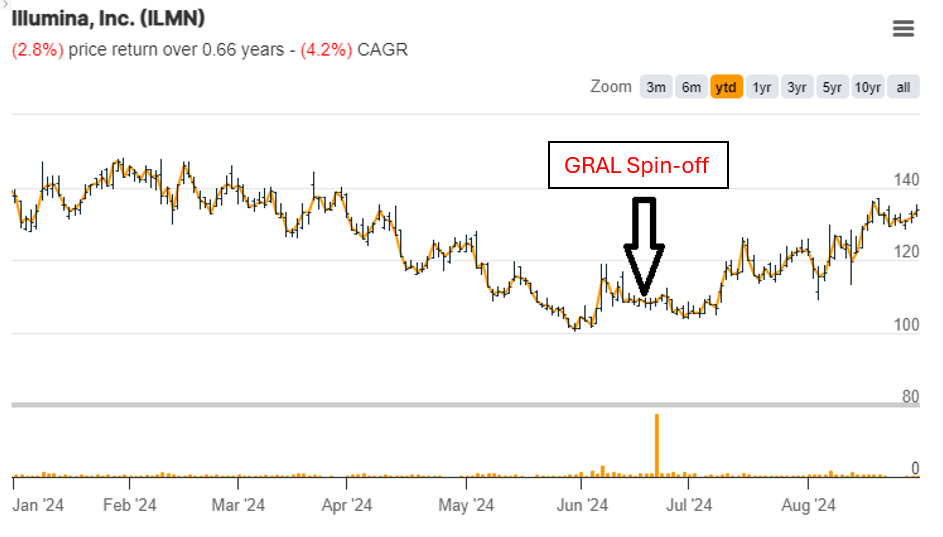
In June 2024, Illumina shed its money burning (but valuable) cancer blood test division Grail (GRAL), and the Remainco quickly re-rated…
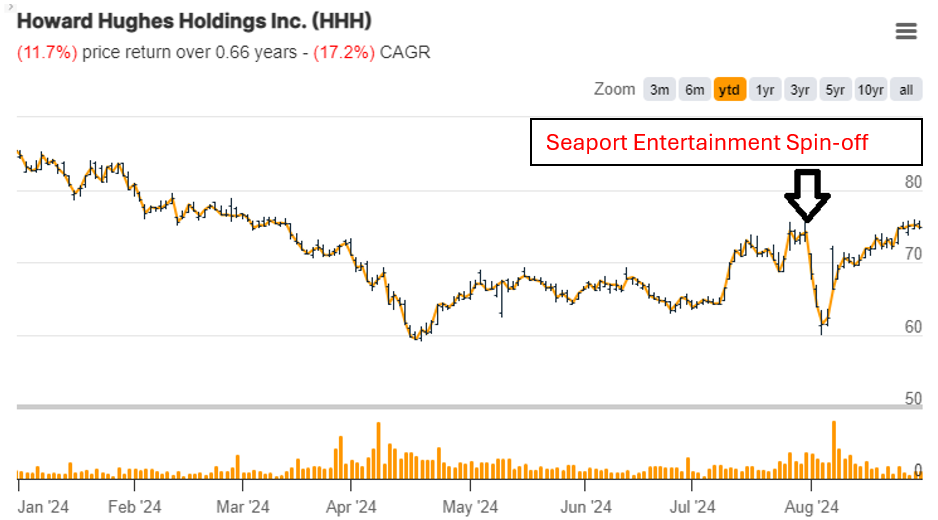
In July, Howard Hughes (HHH) shed its money losing (but valuable) Seaport Entertainment (SEG) division and quickly re-rated higher.
My Favorite Demerger Arbitrage Situation Today
Today, my favorite demerger arbitrage situation is Liberty Global (LBTYA).
The pitch is extremely simple.
Liberty will spin-off 100% of its Swiss telecom business, Sunrise Communications before year end.
Sunrise will pay an annual dividend of CHF 240MM. Assuming Sunrise trades at a 6% yield (Swisscom trades at a 4% yield), it will be worth ~$12 per Liberty Share.
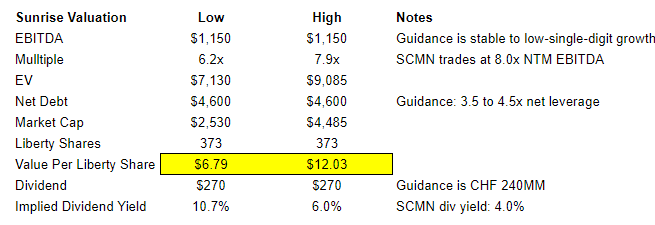
Post spin-off, Liberty will have $9/share of cash and investments (discounting its equity stakes meaningfully) and no debt.

Add $12/share for Sunrise and $9/share for cash investments gets you $21/share of value.
LBTYA currently trades at $20.61.
Does Liberty have any other assets besides Sunrise and cash/investments?
Yes!
It owns a whole slew of other European telecom assets that generate ~$1BN of free cash flow annually.
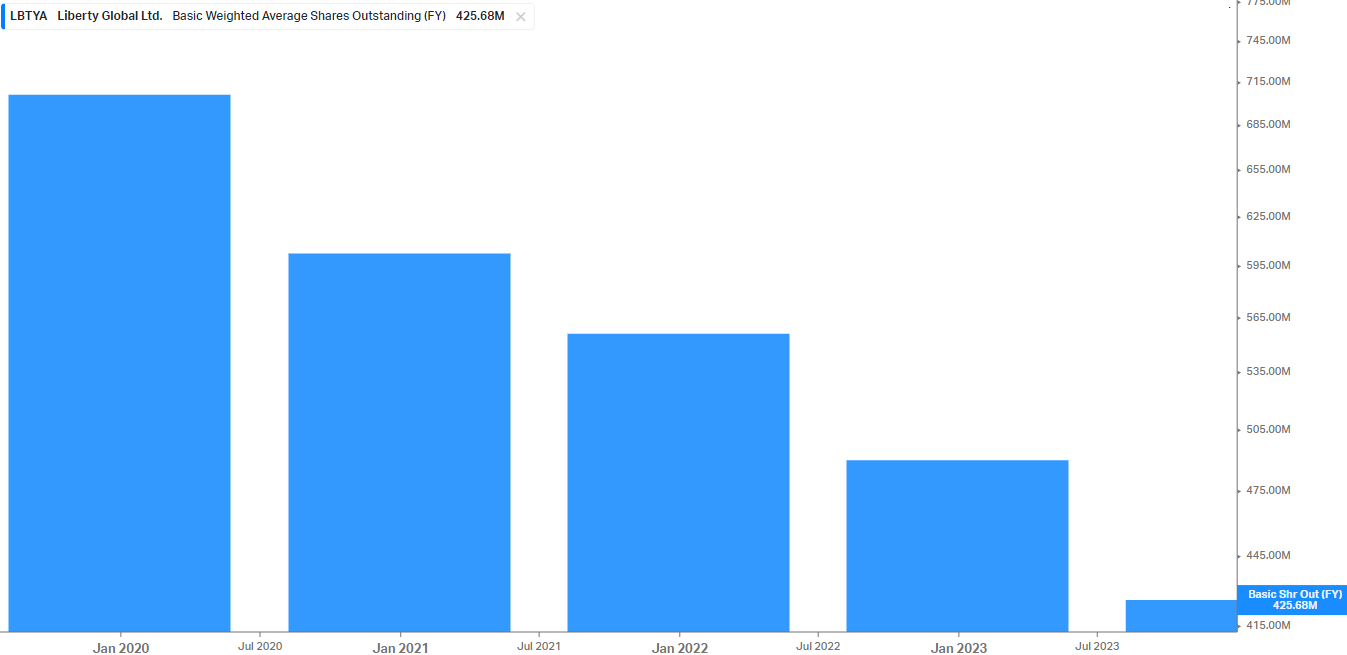
What’s Liberty going to do if the stub doesn’t re-rate after the Sunrise spin-off?
I will give you one hint:

Leave A Comment