

Spin-off Mailbag: Do you trade “when issued” spin-offs?
Recently, a subscriber asked me about trading in the when issued market.
Specifically, he wrote the following:
“I’m looking at Seaport Entertainment (SEG) trading in the when issued market. Do you ever establish a position in the when issued market or do you just wait for the spin-off to take place?”
First of all, what is the when issued market?
The when issued market is a market where securities are traded before they are officially issued. They represent a future obligation to buy or sell a security at a specific price. The idea of spin-offs trading in the when issued market is to help price the stock and promote price discovery.
In general, it’s not a good idea to buy a spin-off in the when issued market.
Why?
Because spin-offs are usually sold indiscriminately.
Let’s take the Seaport Entertainment (SEG), the recent Howard Hughes (HHH) spin-off as an example:
- Size Difference.
- Howard Hughes is a ~$4BN real estate company that spun off the $200MM market cap Seaport Entertainment. Institutional investors have no interest in buying a micro-cap company so it was highly likely that they would sell once they received the spin-off shares.
- Index Fund Selling.
- Seaport Entertainment will not be included in any indexes. Thus, index funds that own Howard Hughes will sell their SEG shares no matter the price.
- Good Co vs. Bad Co.
- Most spin-offs have a “Good Co / Bad Co” angle and Howard Hughes and Seaport Entertainment fit the mold. Howard Hughes (the RemainCo) is viewed as the Good Co while Seaport Entertainment is viewed as the Bad Co? Why? Because Seaport Entertainment represents Howard Hughes’ failed attempt to develop real estate in New York City and it burns $60MM to $80MM every year. Good riddance!
So I was not interested in buying SEG in the when issued market ahead of indiscriminate selling pressure.
And that was the right call because SEG sank like a rock.
What about shorting a spin-off in the when issued market. Is it possible?
The short answer is yes it’s possible but a little complicated.
Here’s how you do it…
You simultaneously:
- Short the parent company
- Buy RemainCo in the when issued market.
This will leave you short the spin-off before regular way trading begins.
Let’s take last year’s Kellogg spin-off to establish how an investor could have shorted the stock ahead of regular way trading…
On September 28 (the day before the KLG spin-off), K was trading at $59.20. At the same time, K-WI (RemainCo) was trading at 55.00.
If you shorted 100 shares of K and simultaneously bought 100 shares of K-WI, your resulting position would have been short 25 shares of WK Kellogg at a cost basis of $16.81 (spin-off ratio was 1:4).
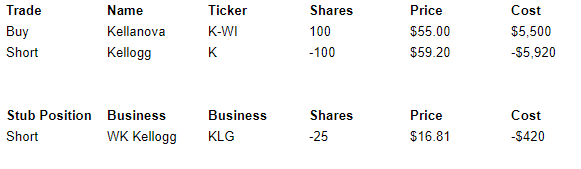
Shortly after the spin-off, KLG sank to $10 so it would have been a great trade.
What’s the catch?
There are a few:
- It’ s capital intensive. You had to deploy over $5000 of capital to create a short position worth $420.
- Sometimes when issued trading is spotty for the RemainCo. In the example of K-WI, only 400 shares traded per day, thus, it would have been impossible to short $KLG in size.
Despite the limitations, it’s worth paying attention to when-issued trading because sometimes there are egregious mispricings.



Excellent discussion Rich.
Rich, with regard to your comment on “capital intensive” (420/5000 = 8.4%), do you have a minimum percentage or hard dollar requirement, that would the trade worthwhile? Thanks!
Pat
Hi Pat, great question. I guess it depends on much you think the spin-off could sell off. In this example, KLK sold off by about 40%. That is a fairly typical sell off from the when issued price. If we shorted the spin-off at $16.81 and covered at $10, we would have made ~$170 on $5,500 capital deployed. It works out to about a 3% return which is not bad at all given the trade played out very quickly.