

Joel Greenblatt Explains Options Prices
You probably know my favorite investment book is Joel Greenblatt’s You Can be a Stock Market Genius.
In chapter 3, Greenblatt dedicates a glorious 61 pages to investing in spin-offs. I’ve read it many times and will probably read it many more times in the future.
But an underrated part of the book (at least for me) is when Greenblatt explains options.
I had never heard options explained so simply and it really resonated with me. Today, I want to share his framework.
I’m going to take his framework (and language!) but swap in Liberty Global (LBTYA), a stock that I like a lot, for IBM which he uses in his example.
Today (9/4/2024), you can buy LBTYA for $19.86.
You can also buy a call (the right but not the obligation) to buy LBTYA at $17.50 with a 10/18/2024 expiration for $2.58.
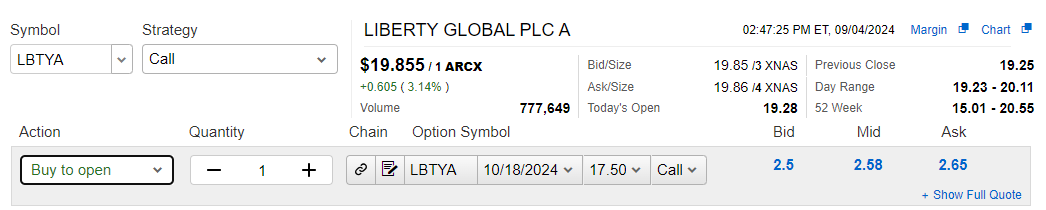
We already know that if it were October 18, 2024, these calls would be worth $2.36. ($19.86 – $17.50).
But today, they are worth more than $2.36.
Why?
There are two reasons:
(1) Leverage
The owner of the calls doesn’t have to lay out $17.50 for another 44 days, yet he is entitled to all of the stock’s appreciation until October 18.
Think about it.
If LBTYA stock were to gain another $5 per share by October expiration, then LBTYA would be trading at $24.86. The owner of stock (if he bought today) would have a gain of $5 on his $19.86 investment.
On the other hand, if the LBTYA October $17.50 calls could be purchased for only $2.36 in September, then the owner of an $17.50 call option would also make $5 in the same period. (That’s because, on the expiration date, the owner of the call could purchase stock at $17.50 and sell it for $24.86; after subtracting the $2.36 initial cost, the profit would be $5.)
This result wouldn’t be fair.
After all, the owner of the stock laid out an additional $17.50 for the same amount of profit. The owner of the call received the upside in LBTYA’s stock without having to invest an additional $17.50.
To compensate for this, the amount of interest that could have been earned on the $17.50 for the 44 days until expiration should be reflected in the price of the call. Assuming a 5-percent interest rate, the interest earned on $17.50 would be approximately $0.11 per share.
So, in addition to what’s known as the intrinsic value of the call—the amount by which the call is already in the money (in our example, the difference between the market price for LBTYA of $19.86 and the exercise price of the call of $17.50, or $2.36)—an imputed interest rate for the amount of money the call buyer didn’t have to lay out for the two months is also included in the call price. That’s how we move from a call price of $2.36—the intrinsic value of the call—to approximately $2.47—the value of the call including the interest on the $17.50 the buyer of the call didn’t have to lay out.
But the call trades at $2.58. What accounts for the nearly $0.11 difference between the $2.47 we already figured and the actual price of $2.58?
(2) Downside protection
Clearly, there has to be another benefit to owning calls—and there is. The buyer of the call can only lose the amount of money invested in the call. While this doesn’t sound all that great, when you compare it to owning the common stock of LBTYA, it is.
This is because, at the October expiration date, if LBTYA stock falls to $17.50 per share, the owner of the call loses his original investment of $258 (the cost of an options contract is the price of the contract x 100) If LBTYA stock falls to $15 per share, the owner of the call loses the same $258—at $10 per share, the call owner only loses $258. Sounding better yet?
It’s pretty obvious what happens to the poor owner of LBTYA stock in this scenario. At a price of $17.50 at the October expiration date, the LBTYA holder is down $2.36 from his purchase price of $19.86. At a price of $15 in October, he’s out $4.86 per share; if LBTYA is at $10 he’s out $9.86 per share.
See, there is an added benefit to owning the calls—it’s the benefit of not losing any more money after the stock falls below the strike (or exercise) price of $17.50 per share.
What’s that worth? Well, in this case, it’s probably worth about $0.11. So, if you pay the $0.11 in “protection money” as part of the purchase price of the calls, then your cost of $2.47 moves closer to the $2.58 price we talked about before. The $0.11 cost for assuming the risk below $17.50 is actually the same as the cost of the put option (that right but not the obligation to sell LBTYA at $17.50).
Two TakeAways
I hope that was helpful.
With that being said, I have two action items for you.
- Read You Can Be a Stock Market Genius if you somehow haven’t.
- If you are interested in using options for spin-off stocks, join the SSI: Ultra waiting list. You will be the first to know when we begin accepting new subscribers.



Leave A Comment